Janacek is an enigma. His music is intensely lyrical, yet fragmentary, its gestures only releasing themselves occasionally from short-breathed, heart-wrenching dissonance into the simplicity of Czech folksongs. His orchestration favours the extreme high and extreme low registers, leaving the registers of the singers relatively unchallenged. Like his contemporary Debussy, he threw off the spell of Wagner’s music, only to write operas in which Wagner’s theories of opera are better exemplified than in Wagner’s own. He wrote operas, not symphonies, and yet in his operas the orchestra does the singing while the voices declaim, even when singing at the top of their range.
As a result, outside his native country his music has needed champions. One such was the Australian conductor Charles Mackerras, and I was lucky enough to hear Katya under his baton in London many years ago. Another was the great Viennese conductor Georg Tintner, and when I first arrived in Australia I heard him conduct several of Janacek’s operas. (Like the other 45 operas in his repertory, he conducted them from memory!) Yet nowadays, as Stuart Maunder laments in the program for the Victorian Opera’s production, Janacek’s operas are rarely performed here.
The latest Janacek champion is Mackerras’ nephew, Alexander Briger, the founder director of the Australian World Orchestra. Harnessing the brilliant young musicians of the Australian National Academy of Music (ANAM), he interpreted Janacek’s score with mesmerising intensity. It is obvious that he loves every phrase of the music, and during the more extended lyricism of the love scene the orchestral sound saturated every nerve-ending of the audience.
Janacek himself wrote the libretto of Katya Kabanova, basing it on the Russian writer Ostrovsky’s play The Storm. Like so many of the great novels and operas of the 19th century, it is about adultery, the two closest models of its plot being Tolstoy’s Anna Karenina and Wagner’s Tristan und Isolde. Yet in neither of these is the plot completely dominated by an old, embittered woman, in this case Katya’s mother-in-law, Kabanicha.
Janacek’s depiction of Kabanicha closely resembles his portrayal of the Kostelnicka in his earlier opera Jenufa; an older woman so ravaged by the cruelty of the patriarchy that she spends her life ensuring that on-one, woman or man, enjoys sexual love. Outraged when Katya “treats her husband like a lover”, or when she tells her son to beat Katya, as she herself beats her uncle Dikoj (brilliantly played by Adrian Tamburini), she fills her entire life with should. Alas, we are not without such powerful, baleful women in Australia; and it made me wonder what force might be behind Russia’s current merciless beating of Ukraine.
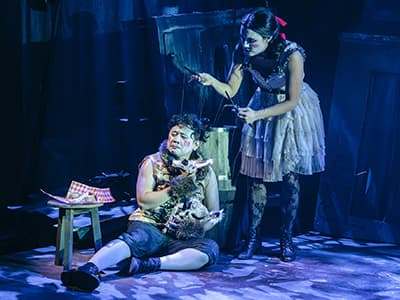
The production took place in that gorgeous old cinema in St Kilda, the Palais. I thought, how appropriate for an ex-Wagnerian like Janacek – Wagner’s theatre at Bayreuth is after all the fore-runner of cinema with its raked seating, invisible orchestra, and capacity for total darkness. And the director, Heather Fairbairn, paid homage to the cinema in several ways. Throughout the overture the credits were displayed on a screen, superposed on scenes of Katya’s eventual suicide. And throughout the action, a cameraman (Benjamin Sheen), dressed in blacks, filmed the singers, a film which was projected in real time on a screen behind the action. So the whole production gave the impression of opera yearning for the condition of film.
This projection of live action onto a screen is something that has been much cultivated this century, and even earlier. It was executed here with great technical mastery. Fairbairn says that its use here has the purpose of magnifying and amplifying Katya’s inner world. For example, at the end of the storm scene, when Katya confesses her adultery to the assembled villagers, the screen magnifies the faces of the crowd, enabling their scorn for her to take up the whole stage, as it might as seen through Katya’s eyes. However, I personally found the saturation of the screen with replications of the stage a bit of a distraction. Even when it worked to give a truly heightened insight into Katya’s state of mind, as in the multicoloured love scene, or the chaotic mad scene at the end, it was redundant, as the music itself was doing the same thing.
This made me reflect that I am of a generation that seeks depth in experience, unlike much younger generations who, I think it is not unfair to say, seek perpetual stimulation. While much of the audience was also of my generation, I applaud Vic Opera’s quest to entice younger audiences by including such imaginative and stimulating elements in this production.
And so far I have hardly mentioned the singers! The cast is uniformly excellent, negotiating the often angular lines of Janacek’s representation of Czech speech patterns with seeming ease. Michael Peturuccelli’s beautiful, “glowing” tenor was very well suited to the character of Katya’s kind husband. Antoinette Halloran is vocally perfectly suited to the part of the evil mother-in-law, and she had a forceful, commanding presence, emitting a sense of actually enjoying being vile. Andrew Goodwin, as Boris, the bored good-for-nothing with whom Katya falls in love, was almost too engaging, his high tenor seductive and persuasive, persuading the audience as well as Katya that his love for her was deep.
But this opera belongs to Katya Kabanova. The screen emphasised this, and the music emphasises this. Desiree Frahn’s portrayal was astoundingly true to the extreme ups and downs of an adolescent girl’s emotional world. Her voice is simply gorgeous. When in her first scena she sings of tending the flowers in the childhood she has only just left, and the ecstasy of prayer in church, she is vocally as whole-hearted as when she goes mad, Ophelia-like, before her suicide. And her interplay with the on-stage camera produced some moments of extraordinary, filmic intensity, such as when Katya gradually realises what she has done by spending a night with Boris. Only in film are the close-ups that show such changing emotions possible.
Both musically and theatrically, this production is a masterpiece. Let us hope that it sows the seeds for a revival of public interest in the music of the great but enigmatic Janacek, to the extent that such productions can run for more than just two nights.
Event details
Victorian Opera presents
Katya Kabanova
Leoš Janáček
Director Heather Fairbairn
Venue: Palais Theatre, St Kilda VIC
Dates: 14 & 16 October 2025
Tickets: from $39
Bookings: www.victorianopera.com.au